
DECODING "ESSENTIAL"
How a Gen Z alignment gap revealed a deeper execution problem and the framework built to close it
About
During this 10-week studio, our team partnered with Samsung Mobile's Global CX Team to investigate a gap between how Samsung intends its "Essential" design principles (Simple, Impactful, Emotive) and how design, product, and engineering teams actually apply them day to day. Through a research phase spanning 9 countries, I helped uncover that Gen Z's weakest brand alignment wasn't a perception problem, it was a translation problem: principles that lived as adjectives on a slide rarely made it into a designer's or engineer's actual workflow. That insight reframed our mission: not just to redefine what "Essential" means, but to design a framework that helps cross-functional teams put it into practice.
Impact
The project delivered two things: a strategic Anchor Framework that gave Samsung's global teams a shared language for "Essential," and more critically a 3-Phase Methodology that operationalized it across design, product, and engineering workflows. Our global survey of 784 participants across 9 countries served as the "reality check" behind this: Samsung scored 85% in Impact but just 62% in Emotive resonance, and the gap traced back not to what teams knew, but to how inconsistently they applied it day to day. The methodology, spanning onboarding, in-process checkpoints, and post-launch reflection, gave teams a repeatable way to close that gap, and directly shaped how Samsung's team began prioritizing Personalization as a core design pillar going forward.
Timeline
Jun 2025- Aug 2025, 2 months
Task
Research
Design System
Framework Design
Team
Scad pro
My Role: UX Researcher & Design Systems Contributor
Research Synthesis: Led linguistic analysis of 564 adjectives and co-managed a 784-participant global survey across 9 countries to quantify Samsung's "Emotive Gap" with Gen Z.
Framework Architecture: Designed the 3-Phase Methodology (Foundation → Application → Reflection), including tools like Principle Checkpoints and a Brand Scorecard, to translate abstract principles into a team's daily workflow.
Cross-Functional Facilitation: Interviewed designers, PMs, and engineers to identify where principles broke down in execution, and used those findings to shape checkpoint touchpoints embedded directly into the design-to-dev handoff.
Concept Validation: Explored the E-Paper "Mini You" concept as a proof-of-point for how personalization could translate into a tangible product direction.
The Problem
When a Design Principle Never Reaches the User
Samsung Mobile's "Essential" principles: Simple, Impactful, Emotive, were meant to guide every product decision. But even strong principles fail when teams interpret them differently: what starts as a shared value gets diluted into spec-heavy, corporate messaging by the time it reaches the user. Auditing 564 real-world adjectives confirmed it, users experience Samsung not as an emotional choice, but as a functional necessity.
Vague Principles
↓
Fragmented Team Interpretation
↓
Spec-heavy Messaging
↓
User Perception: "Cold Tool"
Research Snapshot
The Data Behind the Gap
To move beyond assumption, we audited Samsung's brand language against real user sentiment, extracting 564 adjectives from Samsung.com, tech reviews, and 1,000+ user reviews across Best Buy and Walmart. The result was clear: Apple owns emotive territory (magical, intuitive), while Samsung remains trapped in a functional one (powerful, advanced). We validated this at scale with a Global Semantic Differential Survey across 9 countries and 784 participants: Samsung scored well on Impact (85%) and Simplicity (78%), but dropped to just 62% on Emotive and Gen Z, more than any other age group, described the brand as "Standardized" rather than "Personalized."
The Turning Point
A Shared Vocabulary Wasn't Enough
Our first instinct was that Samsung simply needed a unified language, hence the Anchor Framework. But when we interviewed the designers, product managers, and engineers actually building Samsung's products, a different pattern emerged: the problem wasn't that teams misunderstood "Impactful" or "Emotive." It was that these words never made it past the slide deck. Without a shared process for interpreting, checking, and revisiting these principles across design, R&D, and product, each team quietly defaulted to its own definition and no one had a way to catch the gap until launch.
That shift changed our brief: not another framework to define what "Essential" means, but a system to make sure it actually gets applied.
The Framework
Turning Principles Into a Repeatable System
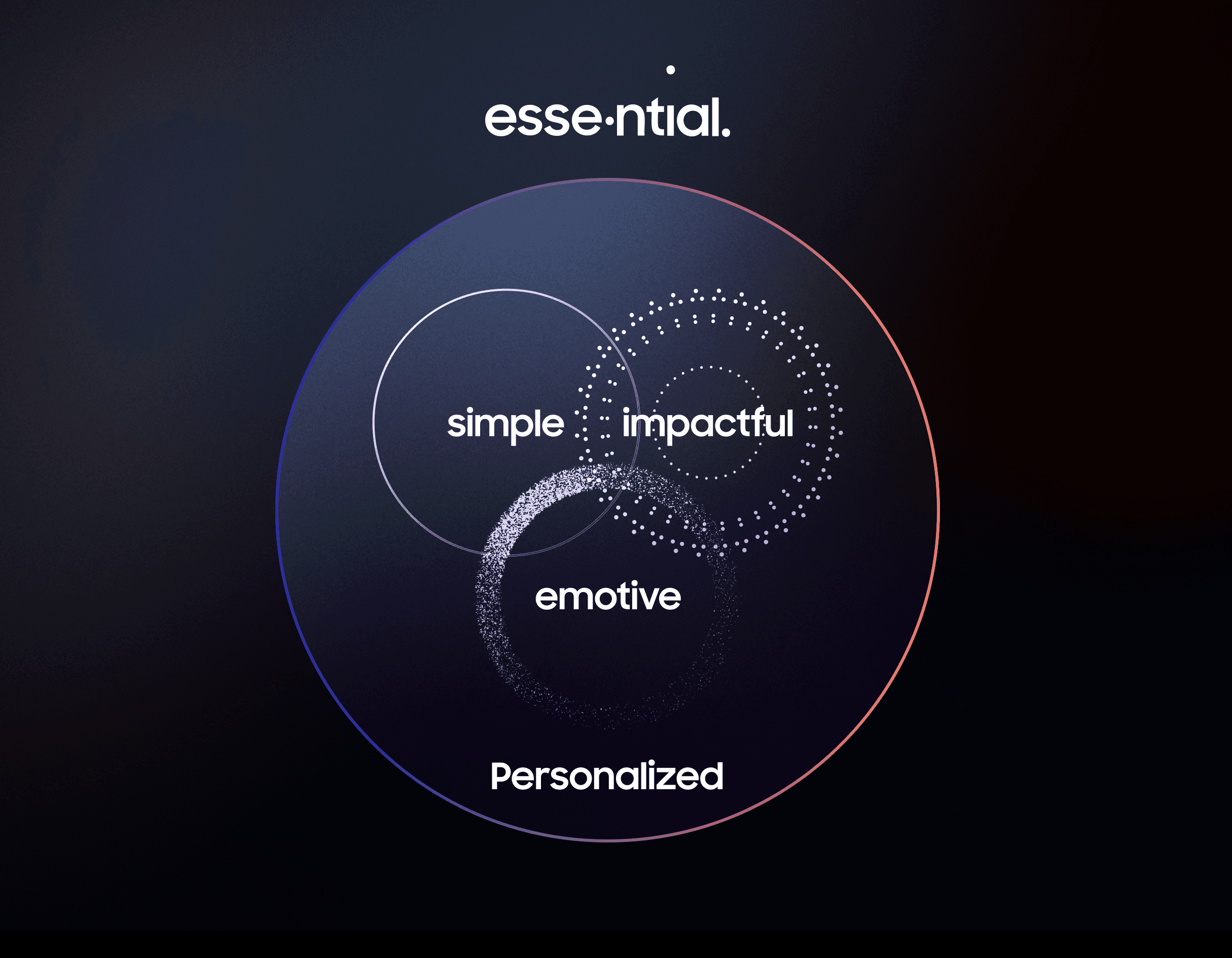
We evolved "Essential" into four principles: Simple, Impactful, Emotive, and now Personalized, each redefined with sharper, more human intent. But redefining the words was the easy part. The real work was building a system that made sure design, product, and engineering teams applied them the same way, every time.
Simple — effortless and purposeful.
Impactful — playful and human.
Emotive — bold and inclusive.
Together, they now point toward one outcome: Personalized.

A 3-Phase Methodology to Make It Stick

Phase 1: Foundation & Onboarding
Teams weren't ignoring the principles, they were inheriting inconsistent, ad-hoc interpretations of them. Onboarding was fragmented, and principles were often the first thing forgotten under deadline pressure. We proposed a Principles Dictionary with clear "Do's/Don'ts" and product-tier examples, paired with a short interactive onboarding module, so every team starts from the same definition, not their own.
Principles dictionary
Interactive onboarding module
Role-specific guides
Phase 2: Application & Team Alignment
The bigger cost showed up later: design intent getting lost by the time R&D touched it, or misalignment surfacing only at review. We proposed Principle Checkpoints, structured cross-functional check-ins at key project stages, plus a Principle Mapping Canvas for teams to trace how a concept expresses each principle, and earlier R&D syncs to align creative direction with feasibility before it's too late to change course.
Principle checkpoints
Principle mapping canvas
R&D early syncs
Phase 3: Post-Launch Reflection & Longevity
Without a feedback loop, principles risk becoming static, applied once, then forgotten. We proposed a Principle Scorecard to evaluate launches against user sentiment (not just sales), paired with retrospectives and a Best Practice Library, so every launch feeds back into how the next team applies "Essential."
Principle scorecard
Best practice library
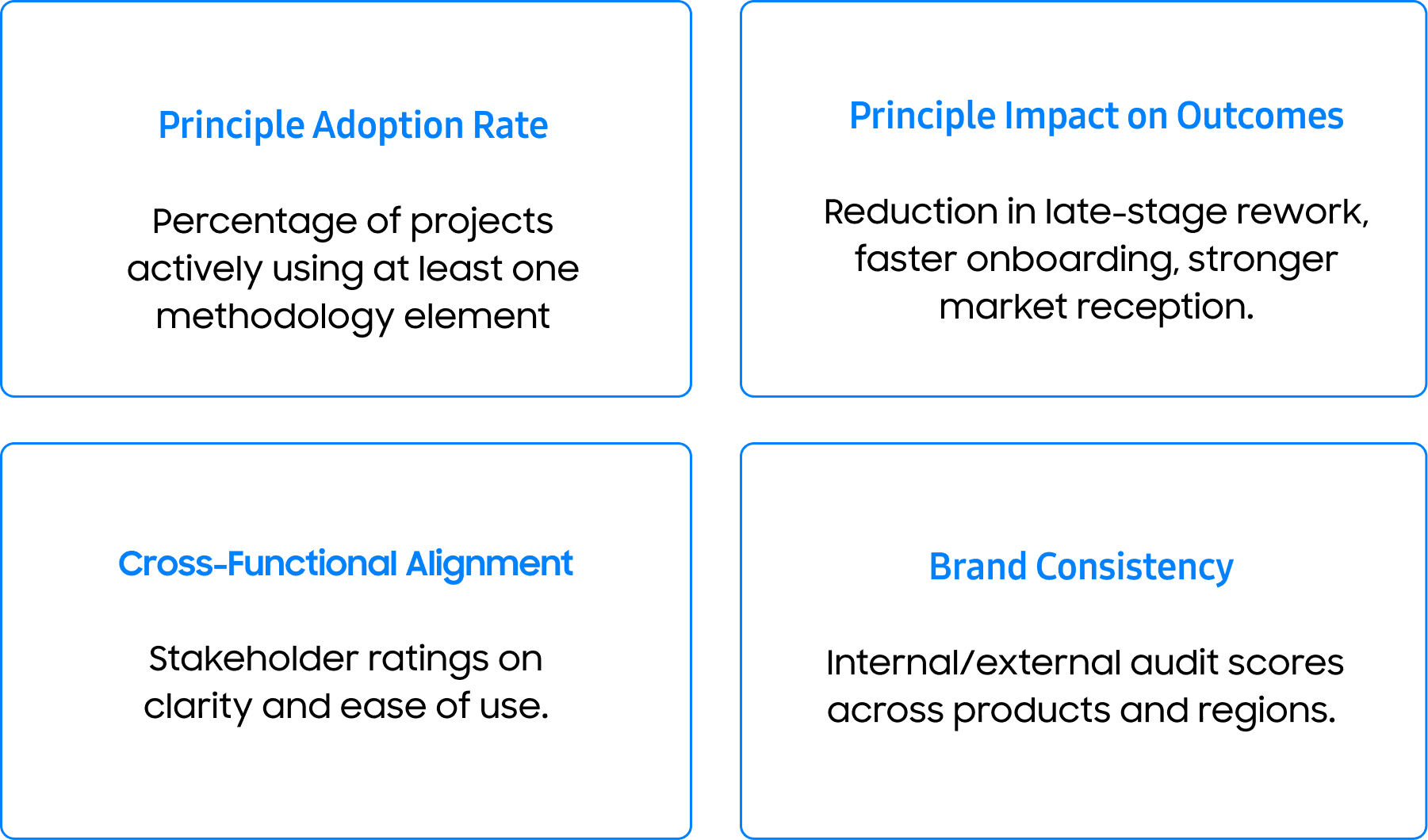
How We'd Measure It Working
A methodology only matters if its impact can be tracked. We defined four success metrics:
A tangible proof point: E-Paper "Mini You"
To make "Personalized" tangible, we explored a concept device: a customizable E-Paper phone cover that lets users change their design in real time, turning a functional accessory into a form of self-expression. It wasn't the deliverable; it was a way to show what the framework looks like when it actually reaches a product.

Takeaways
Takeaway 1
Alignment is a cross-functional problem, not a creative one.
Working with a company at Samsung's scale taught me that the hardest part wasn't defining "good design", it was making sure that definition survived contact with R&D timelines, marketing calendars, and a dozen regional teams. Strategic clarity means nothing if it gets lost in translation between departments.
Takeaway 2
A framework only works if someone owns it.
Our interviews with designers, PMs, and engineers taught me that even a well-designed system fails without clear accountability, someone has to run the checkpoint, someone has to read the scorecard. Designing the artifact was half the job; designing who's responsible for it was the other half.
Takeaway 3
Personalization is a workflow decision, not just a brand value.
Gen Z's disconnect from Samsung wasn't really about taste, it was about whether "Personalized" showed up in an actual product decision, or stayed a word on a slide. That reframed how I think about design principles generally: they're only real if there's a repeatable process that applies them.